 EN
EN
 NL
NL

Raw materials and products that come into contact with ambient air during production, transport or storage are susceptible to oxidation and bacterial growth. This leads to quality loss in the form of changes in smell or taste, discoloration and reduced shelf life. Nitrogen provides an effective solution. In this blog, you will read how nitrogen is applied in the food industry, how it works and what it can mean for your production process.
What is Food Grade nitrogen?
Food Grade nitrogen is nitrogen gas that meets the quality requirements for use in the food industry. The gas is inert, colorless and odorless, and has no impact on the taste or composition of the product. Because nitrogen does not chemically react with food products, it is suitable as a protective gas in direct contact with products.
The quality of Food Grade nitrogen is determined by two factors: purity (the percentage of N₂) and the absence of contaminants such as moisture, dust and oil, in accordance with ISO 8573-1. Both aspects are critical for the safety and quality of the final product.
Why use nitrogen in the food industry?
The use of Food Grade nitrogen and compressed air is mandatory in many food processing companies and improves both product safety and process reliability. Nitrogen replaces oxygen in the direct environment of the product, reducing oxidation and bacterial growth.
This has a direct impact on:
- The shelf life of the final product
- The taste, smell, texture and color of the product
- The safety of the production process
- The results of audits and quality inspections
How is nitrogen used in the food industry?
Modified Atmosphere Packaging (MAP)
In MAP packaging, the air inside a package is replaced with a gas mixture tailored to the product. This MAP gas typically consists of nitrogen (N₂), carbon dioxide (CO₂) and in some cases oxygen (O₂). The ratio varies per product category and determines the extent to which oxidation, bacterial growth and moisture absorption are reduced.
Examples of products packaged this way include cut vegetables and salads, processed meats and poultry, cheese and dairy products, and dry snacks such as nuts and chips.
Nitrogen is the most commonly used gas. With the exception of raw red meat, organ meat, darker parts of poultry and hard cheeses, nitrogen is applied in one form or another in nearly all other food products that benefit from MAP.
The gas ratio in the packaging is precisely controlled using a gas mixer. Avilo supplies high-quality gas mixers that allow multiple gases to be easily connected, ensuring the correct mixing ratio for MAP packaging at all times.
ULO cells and CA/DCA storage
In a ULO (Ultra Low Oxygen) cell, the oxygen level is significantly reduced using nitrogen, slowing down the ripening process of fruits and vegetables. Not only temperature and humidity are controlled, but also the complete air composition.
Suitable for: long-term storage of apples, pears and citrus fruits, storage of bananas and exotic fruits, storage of trees, plants and flower bulbs, and large-scale cold storage facilities up to 500,000 m³
Inerting storage tanks and silos
By filling storage spaces with nitrogen gas, the oxygen level is reduced, structurally preventing oxidation of stored raw materials.
Products commonly inerted include vegetable and animal oils and fats, nuts, seeds and dried fruits, herbs, spices and aromas, and flour, starch and other powder products.
Filling beverages
During the filling of beer, coffee, fruit juices and other beverages, nitrogen is used to prevent oxidation and to build pressure in the packaging. A commonly used method is dosing a small amount of liquid nitrogen into the packaging before sealing, creating overpressure without the use of CO₂.
How does on-site nitrogen generation work?
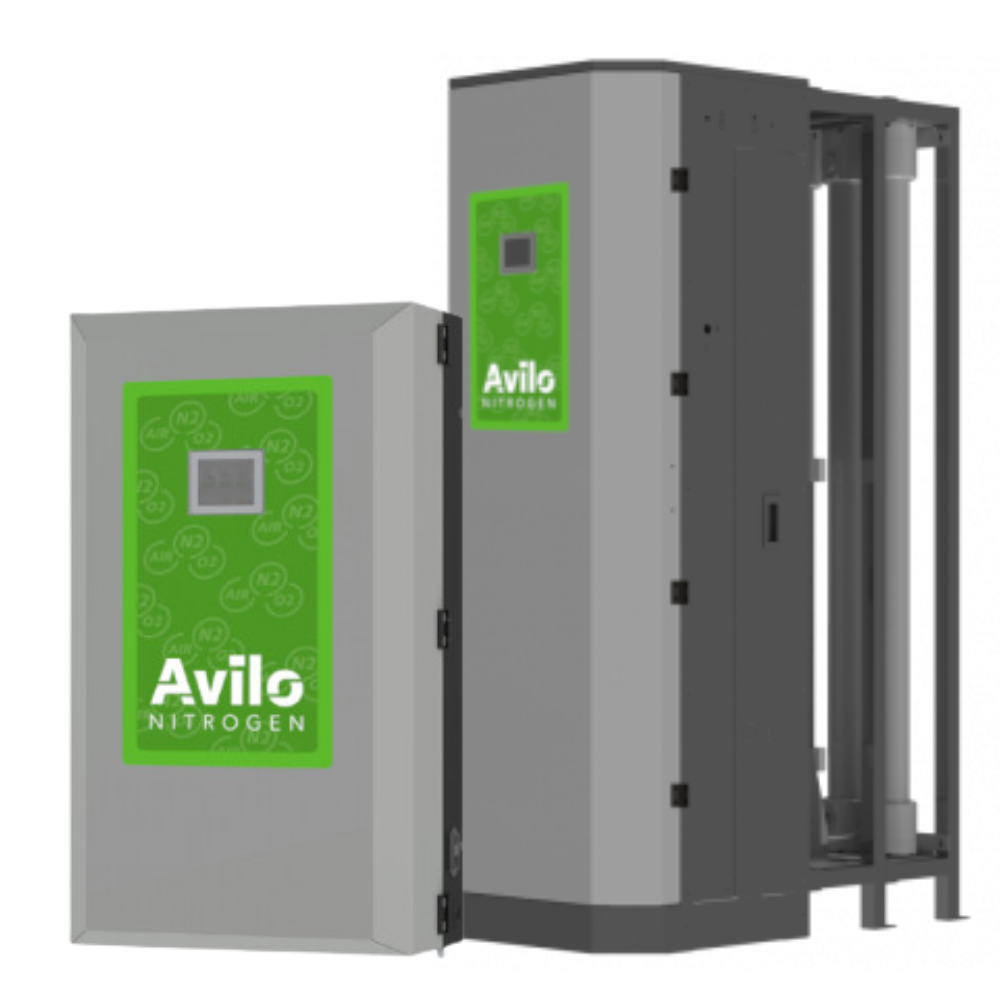
A nitrogen generator separates nitrogen from ambient air using two technologies: membrane technology or PSA technology (Pressure Swing Adsorption).
Membrane technology is suitable for purities up to approximately 99.6% and is widely used for MAP packaging, tank inerting and silo protection. The system is energy-efficient, low-maintenance and provides a continuous nitrogen supply.
PSA technology is used when higher purity is required. PSA systems deliver nitrogen with consistent quality, which is essential in processes where even minimal oxygen presence is undesirable.
The generator automatically adjusts its output to consumption. Once the system is active, production starts and continuously monitors gas quality.
What nitrogen purity do you need?
Not every process requires the same purity. In many cases, higher purity does not provide additional benefits but does increase costs.
|
Process |
Typical purity |
|
MAP packaging (dry products) |
95 – 97% |
|
MAP packaging (meat, fish, fresh vegetables) |
99 – 99.5% |
|
Inerting storage tanks |
95 – 99% |
|
ULO cells and CA storage |
97 – 99.5% |
|
Beverage filling |
99 – 99.9% |
What should you consider?
Gas quality in accordance with Food Grade requirements
Nitrogen and compressed air used in areas where food processing activities take place or in direct contact with food products must meet applicable standards. This concerns not only purity but also the absence of contaminants in accordance with ISO 8573-1.
Continuity of gas supply
Production downtime due to an empty tank or missed delivery has direct consequences for your operations. An on-site nitrogen generator produces continuously and is not dependent on external supply.
Correct sizing
The required flow, purity and working pressure determine the size of the system. An incorrectly sized system leads to overcapacity or process limitations.
Legislation and regulations
Requirements for gas quality in the food industry are becoming increasingly strict. A system that does not comply with applicable standards can result in audit failures.

What are the benefits of on-site nitrogen generation?
- Continuous availability: no dependence on delivery schedules or tank levels
- Guaranteed Food Grade gas quality in accordance with applicable standards
- Ability to set the required nitrogen purity per process
- Lower cost per Nm³ with structural usage
- No rental of tanks or cylinders
- Reduced logistics and administrative handling
Nitrogen for your food production process at Avilo
Avilo is an experienced specialist in Food Grade nitrogen and compressed air for the food and beverage industry. We advise customers on the correct purity and supply systems that comply with applicable food safety standards.
Curious what nitrogen can do for your production process? Contact us for a non-binding consultation or a targeted cost indication.