 EN
EN
 NL
NL

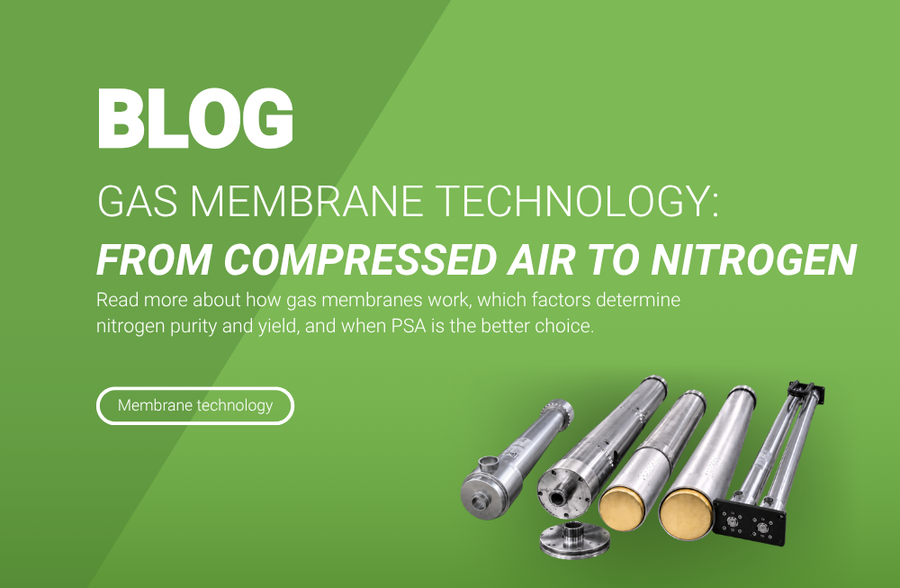
Gas membrane technology separates gases without moving parts, chemicals or heat. A membrane module allows one gas to pass through the wall of a hollow fibre faster than another. It is precisely this difference in permeation rate that makes gas separation possible. This operating principle, based on diffusion and permeation, is specific to membrane generation and distinguishes the technology from PSA generators, where nitrogen is produced by adsorbing oxygen onto a molecular sieve.
In this blog, you will learn how this separation process works, which factors determine purity and output, and when membrane technology is the better choice compared with PSA.
What is gas membrane technology?
Gas membrane technology is a separation technology in which a pressurised gas mixture is passed along a selectively permeable membrane. The membrane consists of thousands of hollow polymer fibres bundled together in a cylindrical module. Each fibre acts as a miniature separator: gases that diffuse quickly through the polymer pass through the fibre wall, while gases that diffuse more slowly remain inside the fibre and continue towards the outlet.
There are therefore no filters that capture particles and no adsorption bed that needs to regenerate. Separation takes place at molecular level and is fully continuous, making the technology low maintenance and quiet in operation.
How does the separation process work step by step?
1. Compressed air preparation
The membrane is the most critical component in the system and also the most sensitive. Oil, moisture and solid particles in the feed air can damage the polymer fibres and cause permanent capacity loss. The compressed air therefore always passes through a series of compressed air filters and a compressed air dryer first. For membrane generation, a maximum pressure dew point of 3 °C applies. In practice, this means a minimum compressed air quality of Class 1.4.1 according to ISO 8573-1:2010, the standard that classifies compressed air quality based on particles, water and oil. You can read more about these classes in our blog about ISO 8573-1 and compressed air quality.
2. Supply to the membrane module
The clean, dry compressed air enters the fibre bundle under pressure. The pressure inside the fibres is high, while the outside of the fibres is at ambient pressure. This pressure difference is the driving force behind the entire process.

3. Selective permeation
The pressure difference forces gas molecules through the fibre wall, a process known as permeation. The rate at which this occurs differs significantly between gases:
water vapour permeates very quickly;
oxygen permeates quickly;
argon permeates slowly;
nitrogen permeates the slowest.
4. Product and permeate
What remains inside the fibre is a nitrogen-rich, dry gas stream: the product. The gases that have passed through the fibre wall form the permeate and are discharged into the surrounding environment as oxygen-rich air. Because part of the argon remains in the product stream, the achievable nitrogen purity is limited to a maximum of 99.6%.
The same principle can also be applied in reverse. With an oxygen membrane, the gas that remains inside the fibre is not the product. Instead, the rapidly permeating fraction is used, producing an oxygen-enriched gas stream.
What determines the performance of a gas membrane?
Four parameters together determine the performance of a membrane:
Operating pressure
A higher feed pressure increases the pressure difference across the fibre wall and therefore increases the output per module. However, every module has a maximum operating pressure.
Temperature
Warmer feed air allows gases to permeate more quickly, increasing the flow rate. At the same time, the difference in permeation behaviour between the gases decreases, which reduces the achievable purity.
Flow rate and purity
This is the most important trade-off in the entire system design. If the air flows more slowly through the module, more oxygen has time to permeate through the membrane and the nitrogen purity increases. However, the amount of nitrogen produced decreases. If you require a higher flow rate, this comes at the expense of purity.
Air factor
The amount of compressed air required per m³ of nitrogen. In practice, this ratio has a major influence on your energy consumption: the compressor consumes the energy, not the membrane itself.
The final two points explain why specifying the highest possible purity often results in higher costs than necessary. Every additional percentage point of purity requires disproportionately more compressed air. It is therefore important to first determine the purity your process actually requires.
Membrane or PSA?
Both technologies produce nitrogen from ambient air, but they do so in fundamentally different ways. A PSA generator uses a carbon molecular sieve that adsorbs oxygen and regenerates periodically. As a result, the process operates cyclically and can achieve residual oxygen levels in the ppm range.
Membrane generators operate continuously, offer a faster start-up time, contain fewer moving parts and produce less noise. For applications with moderate nitrogen purity requirements, such as tank inerting, blanketing and purging pipelines, membrane technology is generally the simplest and most robust choice. Membrane generators can provide nitrogen purity levels of up to 99.6%. If a higher purity is required, PSA becomes the more suitable option.
Where is gas membrane technology used?
- Oil, gas and chemical industries: inerting of tanks, pipelines and reactors, including offshore locations where compact, low-maintenance systems are required.
- Food and beverage industry: protective atmospheres during storage, filling and transport.
- Plastics and electronics industries: dry, oxygen-reduced atmospheres in production processes.
- Fire prevention and tyre inflation: applications where reducing the oxygen concentration is the objective.
- Laboratories: nitrogen as a carrier and drying gas for analytical equipment such as LC-MS, GC-MS and TOC.
Service life and maintenance
A membrane module has no moving parts and therefore requires very little maintenance. However, its service life cannot be expressed as a fixed number of years. It depends on the quality of the incoming compressed air, inlet and ambient temperatures, vibrations and the number of operating hours.
Of these factors, compressed air quality has the greatest influence. Maintenance therefore mainly focuses on the air treatment system: oil, moisture and particles can irreversibly damage the fibres. A decrease in purity or a reduction in output under unchanged operating conditions indicates that the membrane may need to be replaced.
Gas membranes from Avilo
Avilo is a Parker distributor and Authorised Repair Center in the Benelux. We supply HiFluxx and SmartFluxx nitrogen membranes and EnOxy oxygen membranes. We also design and build complete customised nitrogen generators.
Are you looking for a separate membrane module for your own machine or a complete system? We can calculate which configuration best matches your required purity, flow rate and energy consumption. Contact us for a no-obligation consultation or cost estimate.