 EN
EN
 NL
NL

What does on-site nitrogen production cost?
On-site nitrogen production is increasingly applied as an alternative to cylinders or bulk supply. It offers control over availability, costs and quality. However, the total cost depends on several technical and operational factors. In this blog, we explain what the cost components are and what determines whether they are high or low.
What are the cost components?
The cost of on-site nitrogen production consists of several elements. The main components are the investment in equipment, installation and operational costs during use.
When purchasing a nitrogen generator, it is essential to clearly define the application requirements in advance. Consider the required nitrogen purity, flow rate and pressure. These specifications largely determine the type of system and therefore the total investment.
In addition to the generator itself, auxiliary equipment must be considered, such as a compressor, air dryer, filters and a buffer vessel. Installation and commissioning are also part of the total cost.
What determines whether costs are high or low?
Flow rate
The required nitrogen volume per hour or per minute directly affects system size. Higher flows require larger and more capital-intensive generators.
Nitrogen purity
Not every application requires the same purity level. The higher the required nitrogen percentage, the more compressed air is needed to achieve it. A purity of 99.999 percent results in higher costs compared to applications where 95 to 97 percent is sufficient.
Pressure level
Systems operating at higher pressure levels are more costly. Higher pressure also impacts maintenance costs. In addition, a nitrogen booster compressor may be required.
Technology
The selected technology plays an important role. PSA systems are suitable for higher purities, while membrane systems are often used for lower purity levels. The technology determines not only the price, but also system performance and efficiency.
Additional options and configuration
Additional features such as advanced control systems, monitoring, datalogging or integration with existing systems increase the investment. These options can contribute to improved process control and reduced operational risks.
Operational costs
In addition to the initial investment, ongoing costs must be considered. These include electricity consumption, periodic maintenance and consumables such as air filters. These costs are predictable and form a significant part of the total cost of ownership over the system’s lifetime.
Investment level indication
The investment in a nitrogen generator strongly depends on capacity and specifications. The indications below provide a general overview.
- Low-capacity nitrogen generators: approximately €5,000 to €25,000
- Medium-capacity nitrogen generators: approximately €25,000 to €150,000
- High-capacity nitrogen generators: from €150,000 and above
These amounts are indicative and depend on configuration, technology and additional options.
Why is on-site nitrogen production better than bulk supply?
On-site nitrogen production offers maximum control over availability, costs and quality. Instead of relying on deliveries, logistics planning and fluctuating market prices, you produce nitrogen exactly when your process requires it.
Where bulk supply involves storage, rental tanks and evaporation losses (a liquid nitrogen tank can lose 0.5% to 3% of its content per day without consumption), an on-site system produces only what is actually needed. This prevents waste and unnecessary costs.
The cost structure also becomes more transparent and predictable. Instead of separate rental, transport and delivery costs, operational expenses mainly consist of energy and maintenance. This results in stable costs per cubic meter of nitrogen.
In addition, transport movements and the rental storage of liquid nitrogen or cylinders are eliminated. This contributes to a safer working environment and reduced environmental impact. With an on-site system, you have full control over purity, flow and pressure, increasing process reliability and business continuity.
Case study
LC-MS laboratory application

For an LC-MS laboratory application, a reliable and stable nitrogen supply is essential. In this example, a nitrogen flow of 23 L/min is required at a purity of 98%, with an average use of 16 hours per day. The nitrogen can be supplied by a membrane nitrogen generator with integrated compressed air supply, eliminating the need for external gas deliveries and cylinder replacements.
Thanks to the predictable consumption profile and the relatively moderate purity requirement, this solution can achieve a payback period of approximately 2 to 3 years compared to traditional cylinder supply.
Nitrogen supply for food packaging 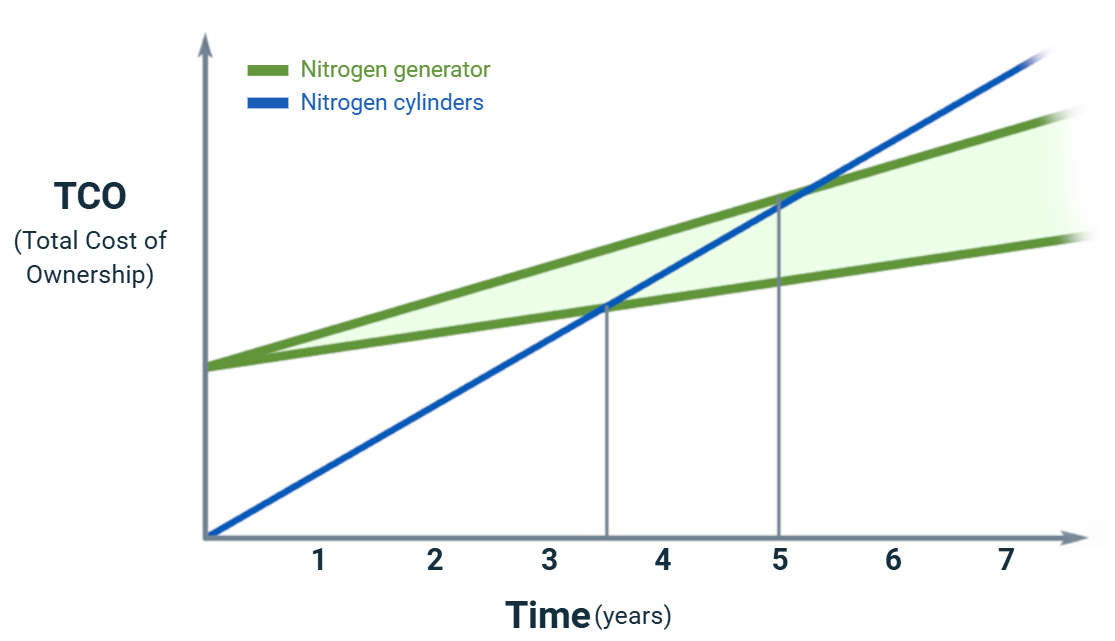
In food packaging applications, nitrogen is often used to extend product shelf life or safeguard ingredient quality. In this example, the required nitrogen capacity is 15 Nm³/hour at a high purity of 99.99% and an operating pressure of 7 bar(g).
The installation operates continuously (24/7), resulting in significant annual nitrogen consumption.
Due to continuous operation and higher purity requirements, the investment in a nitrogen generator including compressed air supply is higher than for laboratory applications. Nevertheless, a payback period of 3.5 to 5 years is typically achieved, after which the user benefits from low operational costs and a stable nitrogen supply.
Would you like to know what on-site nitrogen production costs for your application? Avilo analyzes your nitrogen demand and quickly provides insight into the required investment and operational costs. Contact us for a tailored cost indication.