 EN
EN
 NL
NL

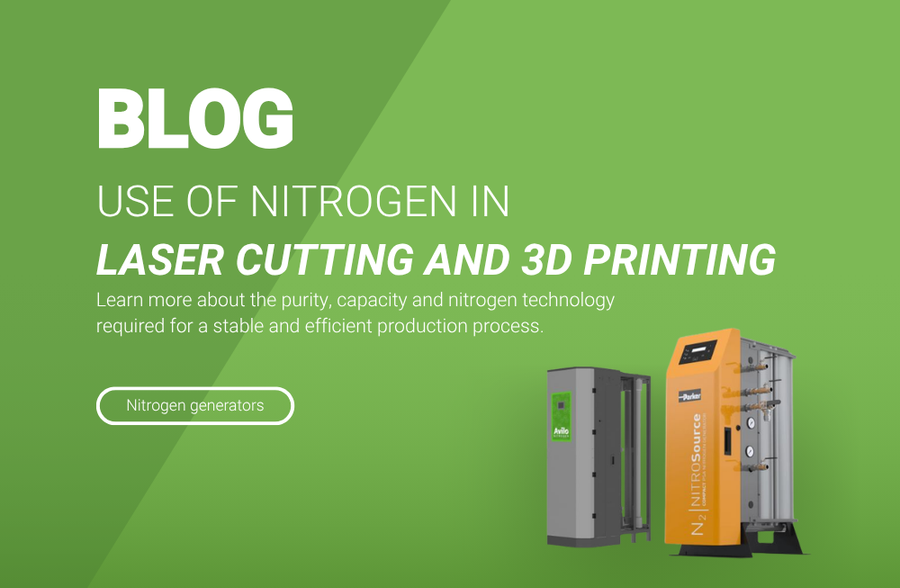
In laser cutting and 3D printing, material is locally melted or sintered. At these temperatures, oxygen from the ambient air reacts with the material. Nitrogen displaces oxygen from the process zone and keeps the process atmosphere controlled.
In this blog, you can read how nitrogen is used in laser cutting, metal 3D printing and polymer 3D printing, which nitrogen purity levels are commonly required for each application and what to consider when sizing a nitrogen system.
Why is nitrogen required for laser cutting and 3D printing?

Nitrogen is used to displace oxygen from the process zone. At high temperatures, oxygen reacts with the material being processed and forms oxides, which affect the quality of the cut edge or printed component. Under normal process conditions, nitrogen is inert and reacts little or not at all with the material in most industrial applications.
When laser cutting metals, iron and chromium oxides can form on stainless steel and aluminium oxide can form on aluminium. The cut edge may discolour and oxidise, requiring additional finishing and potentially affecting corrosion resistance.
In metal 3D printing, excessive oxygen concentrations affect the material properties and the quality of the component. With polymer powder, prolonged exposure to oxygen and heat causes degradation, making the powder less suitable for reuse. Nitrogen or argon is used as a shielding gas, depending on the material and process.
Nitrogen as a cutting gas in laser cutting
Nitrogen has three functions in laser cutting:
-
it displaces oxygen around the cutting front;
-
it removes molten material from the cut;
-
it protects the cutting zone and laser optics against contamination.
For stainless steel and aluminium, nitrogen is used when a clean cut edge with minimal oxidation is required. With the correct process settings, the cut edge can be processed immediately, for example by welding or coating.
The purity determines how much oxygen is carried with the cutting gas: at 99.9% N₂, the gas stream still contains approximately 1,000 ppm oxygen, while at 99.999% N₂ this is approximately 10 ppm. The required purity depends on the material, sheet thickness, cutting speed and cut-edge requirements. The specifications of the laser cutting machine are decisive.
Laser cutting requires a high nitrogen flow, particularly at higher cutting speeds, greater sheet thicknesses and high gas pressures. A booster and buffer vessel ensure sufficient pressure and capacity remain available during peak demand.
Nitrogen in metal 3D printing: SLM, DMLS and LPBF
Metal 3D printing requires a process atmosphere with a low oxygen concentration. Technologies such as Selective Laser Melting (SLM), Direct Metal Laser Sintering (DMLS) and Laser Powder Bed Fusion (LPBF) build a component layer by layer from metal powder. Before printing begins, the process chamber is purged with an inert gas. During printing, a controlled gas flow removes smoke, spatter and condensate from the laser zone.
The purity requirement is high. Many systems operate with nitrogen at a purity of 99.99% or higher, although the exact specification varies by machine and application.
Nitrogen or argon for metal 3D printing?
The choice between nitrogen and argon depends on the material and the machine. Nitrogen is used for steel grades such as 316L, 17-4 PH and tool steel. For reactive materials such as titanium, argon is generally used because nitrogen forms nitrides at high process temperatures. For aluminium and nickel alloys, the specifications of the machine and material manufacturer are decisive.
Nitrogen in polymer 3D printing: SLS
In Selective Laser Sintering (SLS), polymer powder, such as PA12, is processed layer by layer using heat and a laser. During this process, the powder remains at an elevated temperature for an extended period. In the presence of oxygen, the material degrades, making the powder less suitable for reuse.
Industrial SLS machines therefore operate with nitrogen. This contributes to a stable process, consistent product quality and a longer usable life of the powder, helping to control material costs per component. A protective atmosphere is also used during powder storage, conditioning and sieving, although a lower purity is generally sufficient than inside the process chamber.
What nitrogen purity is required for each process?
The required nitrogen purity ranges from 99% for inerting powder storage to 99.999% for critical cut edges. A purity that is too low can compromise process and product quality. A purity that is unnecessarily high increases compressed-air consumption and therefore energy costs, without providing an advantage in every application.
|
Process |
Typical purity |
|
Laser cutting stainless steel and aluminium, visible or weld-ready cut edge |
99.95 – 99.999% N₂ |
|
Laser cutting, non-critical cut edge (subsequent coating) |
99.5 – 99.9% N₂ |
|
Metal 3D printing (SLM, DMLS, LPBF) |
99.99% N₂ or higher |
|
Polymer 3D printing (SLS) |
99.5 – 99.99% N₂ |
|
Inerting powder storage and sieving stations |
99 – 99.9% N₂ |
Indicative values. The specifications of the equipment and the requirements of your end product are decisive.
Nitrogen generator: what is the difference between membrane and PSA technology?
The difference between membrane and PSA technology lies in the achievable purity, energy consumption and maintenance requirements. A nitrogen generator separates nitrogen from ambient air using one of these two technologies.
Membrane technology produces nitrogen with a purity of up to approximately 99.6% N₂ and offers low energy consumption and limited maintenance requirements. This purity is sufficient for inerting powder storage and for cutting applications where the cut edge will subsequently be finished. PSA technology (Pressure Swing Adsorption) produces nitrogen with purities of up to 99.9995% N₂ and is used for laser cutting applications requiring a clean, oxide-free cut edge and for metal 3D printing.
Purity is not the only factor that determines the choice. The required flow rate, operating pressure, consumption profile and number of connected machines are also important.
What to consider when sizing a nitrogen system
Capacity, operating pressure and peak demand
The requirements of the machine and the end product are decisive, not the highest achievable value. Flow rate, purity and operating pressure together determine the required system size. An undersized system cannot provide sufficient capacity during peak demand, while an oversized system results in unnecessary investment and operating costs.
Dry and oil-free gas
Moisture and oil residues in the feed gas can affect process quality and, in laser systems, cause contamination of the optics. Filtration and drying in accordance with the relevant ISO 8573-1 classes therefore form part of a properly designed compressed-air and nitrogen system. The required quality class depends on the application and equipment specifications.
Continuity of the gas supply
A 3D printing job can continue for dozens of hours. An interruption or insufficiently stable process atmosphere can compromise the quality of the build and result in rejected parts. An on-site nitrogen generator provides continuous production and reduces dependence on external gas deliveries and cylinder changes.
Safety in the installation area
Nitrogen displaces oxygen, not only inside the process chamber but also in the area where the generator and buffer vessel are installed. Oxygen monitoring and adequate ventilation should therefore form part of a safe installation and the associated workplace risk assessment.
Benefits of an on-site nitrogen generator
A nitrogen generator produces nitrogen from ambient air whenever the process requires it. This provides the following benefits:
-
continuous availability without dependence on delivery schedules or cylinder changes;
-
the purity can be set according to the requirements of each application;
-
lower costs per Nm³ for continuous and high consumption;
-
no rental costs for cylinders or tanks and no transport costs;
-
the system can be expanded when an additional machine or production line is added.
Nitrogen for your laser cutting or 3D printing process
Avilo supplies and installs nitrogen and compressed-air systems for the metalworking and manufacturing industries. Together with you, we determine the required purity, pressure and capacity for your machines and supply complete systems, including boosters, buffer vessels, filtration and drying. Contact us for a no-obligation consultation or a cost estimate for your application.